Showing posts with label history blogging. Show all posts

Saturday, June 16, 2018

Over 100 Years of American Film History in 1 Spreadsheet

Click here for the spreadsheet
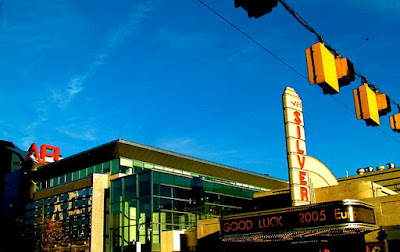

Entrance and marquee of the AFI Silver movie theater
The American Film Institute's theater outside Washington, DC -Photo by Kate Mereand


Twenty years ago on June 16th 1998, I was on vacation in the Outer Banks, and I couldn't tear myself from a show on CBS. Even as a relatively young person, I already had the priorities of a octogenarian. While the people I was vacationing with were busy doing things like partying in the sand, relaxing by the pool, or playing cards and games in adjacent rooms, I was glued to the television.  Needless to say, I was not the coolest guy on the trip. I even grabbed my artist sketch pad I had brought to do drawings, so I could keep notes on the proceedings. My priorities may not have been yours, but, dammit I was committed to them.

The American Film Institute had put together a TV special based on counting down the one hundred greatest American films of the 20th Century. It was a broadcast so specifically designed to appeal to all of my key interests that to this day I worry I may have been used as a guinea pig in some scientific experiment that designed it. I loved movies. I loved ranking things. I have an inherent subservient tendency that love when authority figures tall me what is valuable in art. That's why I love when the Oscars declare with autocratic confidence what was best in film in a given year.  Well this special, titled AFI's 100 Year... 100 Movies, felt like an Oscar ceremony for a whole century of movies!

A love affair began between me and the American Film Institute that continues to this day. The next day I all I wanted to do was talk about the list with people. I want to debate it, and analyze it, and break it down to the nth degree. Instead of wasting the wall space of my bedroom on photos of supermodels or rock stars I clipped a newspaper article with the AFI's list and taped that up.  Years later I would rejoice at the opportunity to move close to the AFI Silver theater in Maryland. I was so excited to take part in their many events celebrating the past and present of filmmaking. Then, like any good creep, I would then try to form a relationship with the good folks there over the internet.

In the years following my initial introduction to their work AFI created more rankings shared across more specials. Like Waylon Smithers with Mr. Burns, I would dutifully knowledge each one, copy down everything they said, and nod in agreement. Over the years the AFI ranked the 100 greatest comedies, the 100 greatest romances, the 100 most thrilling movies, the 100 most inspiring movies, the 50 greatest heroes and 50 greatest villains, the Top Ten of ten different genres of film, and several more lists denoting cinematic greatness. I recorded all of these carefully in notebooks before moving on to spreadsheets on a computer. While the AFI released their final list ten years ago, I have gone back to those lists over and over again for my own purposes.

Eventually, I began to consider the idea of compiling all of those lists into a single resource. In a move that my therapist called "an obsessive's dream" I took it upon myself to create one comprehensive List of Lists ("Because YOU demanded it!"). Thankfully AFI was generous enough to share tons of very useful information on their website. There I could find the lists from their 13 special events and the background information of all the lists of nominated films they used to build their rankings on their website. From those raw materials I crafted a single spreadsheet to summarize everything that was great from over 100 years of American film history. 

A cluttered table of papers and a tablet with infor about movies
If you think my work with AFI lists is obsessive, you should see my Oscars research

Now here comes the part of the piece where I describe my methodology in excruciating detail that almost no one will care about. However I have spent too much time in the company of academics to skip this step. So if you want to insight into my obsessive mind, read on! Everyone else can skip to the next picture. After that I will talk about fun things you can do with the List of Lists.

The first step in making a List of Lists is determining all the lists you have to list. Over 11 years the AFI produced 13 events announcing a set of rankings. They were, in chronological order:
  • June 16, 1998- AFI's 100 Years...100 Movies, ranking the 100 best American movies to that point all-inclusive (all other lists will also be limited to films produced in the United States or with major involvement from Americans) 
  • June 16, 1999- AFI's 100 Years...100 Stars, ranking the 25 greatest male and 25 greatest female movie stars who had made their film debut before 1950 or who had died prior to the creation of the list (so more like the 50 most popular stars you'll find on TCM)
  • June 13, 2000- AFI's 100 Years...100 Laughs, ranking the 100 greatest comedies
  • June 12, 2001- AFI's 100 Years...100 Thrills, ranking the 100 most thrilling, or "pulse-pounding" in the words of the telecast, movie; there was not a strict genre restriction on this list like there were on others
  • June 11, 2002- AFI's 100 Years...100 Passions, ranking the 100 greatest love stories in films both dramatic and comedic (but disappointing some, none that were pornographic)
  • June 4, 2003- AFI's 100 Years...100 Heroes & Villains, ranking the 50 greatest heroes and 50 greatest villains portrayed in films
  • June 22, 2004- AFI's 100 Years...100 Songs, ranking the 100 greatest musical moments, not limited to those in movie musicals or even songs written for films, rather any instance of music being used in the body of a movie
  • June 21, 2005- AFI's 100 Years...100 Movie Quotes, this one should be self-explanatory
  • September 23, 2005- AFI's 100 Years of Film Scores, ranking the 25 greats film scores, this was presented in a special one-night only event at the Hollywood Bowl instead of a broadcast
  • June 14, 2006- AFI's 100 Years...100 Cheers, ranking the 100 most inspiring films; again this list was not confined to any specific genre
  • September 3, 2006- AFI's Greatest Movie Musicals, ranking the 25 greatest musicals, this was also presented at a live performance rather than over television
  • June 20, 2007- AFI's 100 Years...100 Movies – 10th Anniversary Edition, revising the original list of the 100 greatest movies, both to incorporate films since released and changing opinion regarding certain films (so goodbye to 1915's The Birth of a Nation)
  • June 17, 2008-AFI's 10 Top 10, ranking the 10 greatest films of 10 genres: animated films, court room dramas, epics, fantasy, gangster movies, mysteries, romantic comedies, science-fiction, sports movies, and westerns.  

My main purpose for this spreadsheet is to create a database of movies judged to be of holistically high quality. That means that some of these lists would not be conducive to my goal. 

The list of 50 stars was the most difficult to deal with as I could not figure how to account for it. The AFI surely did not mean it as an endorsement of every film in the combined body of work of over 50 actors. I determined that The Plastic Age did not merit inclusion in the spreadsheet by virtue of an uncredited appearance by Carole Lombard. Had the AFI based inclusion on that list for specific films starring the actors as they did with the heroes and villains then I could use it. Instead I did not include that list at all.

Also I divided the 10 Top 10 into ten separate lists. Since each top ten was based a specific list of nominees that occasionally overlapped, it seemed appropriate to treat them as distinct entities.


The list of heroes and villains had some unusual features. Heroes and villains were both given the same number of ranked spots, but were not equally represented among the nominees. Further the nominees were not categorized as heroes or villains. Thus I treated it as one list of characters with split rankings.

This left me with a total of 21 lists to consider. The lists represented a combined 1,949 films ranging chronologically from 1912 to 2006. Some where represented in multiple rankings, while a majority of them were only nominated on a single list. Simply listing all the nominated films would leave me with a useless catalog that would not communicate the various ranking the AFI went to so much trouble to create. To try to capture the relative merits of each movie according to the lists, I would need a system to account for the frequency and placement of a film among the combined rankings.

First I decided to divide the rankings into tiers. I did not want to simply rank films by their ordinal number for a few reasons. There was no clear way to deal with the hundreds of nominees which had no ordinal ranking. Since I cannot be privy to the specific mechanations that determined the rankings, I couldn't be sure how much value to assign the difference between the 53rd and 52nd film on a list. However tiering could assign proper weight to the kind of intuitive ranges that the juries creating this lists likely had in the back of their minds. In a list of 100 films distinguishing the top 50 from the top 25  or top 10 makes sense. Tiers also made it easier to compare scores across lists.

From there I would assign each film a score for appearing on a list in any position weighted relative to it that position. I awarded a movie a number of points equal to the number of films nominated for that list divided by how many other films fell in the same tier (or higher) as that movie ( #Nominees/# in Tier=Points). If that quotient didn't result in an even number I rounded to the nearest integer. Thus each film that was nominated and not ranked earned 1 point (#Nominees/#Nominees=1). Then the higher up a list a movie ranked the more points it would earn. Lists of 100 would be have tiers for their top 50 and top 25. All lists had a tier for the top ten. Then the top film on each list was awarded as many points as there were nominees in the list ( by the logic that it was in a tier of 1 and #Nominees/1= #Nominees). Isn't this all sounding more interesting than anything you could do on a subtropical beach?

Ranked films that were drawn from larger pools of nominees (like the 500 nominees considered for the greatest comedies) earned more points than those from smaller pools (the 10 Top 10 lists each came from only 50 nominated films). That gave appropriate weight for films that stood out among crowded fields versus those selected within narrow genre restrictions.

The heroes and villains list again posed some challenges. Since I had decided to treat it as one list of 100 characters, I chose to split the points evenly between the two sub-categories. So I awarded the top 25 heroes and top 25 villains the number of points they would have earned for being in the top 50 of another list. Then I created a top 20 tier instead of a top 25 to include an even number of both goodies and baddies while also observing a number that seems like an intuitive division within such a list. The top ten and number one of both lists were treated as ties and shared the respective points (i.e. #Nominees/2).

Because the 10th Anniversary was openly an attempt to improve upon the original list by altering the rankings of some of the films, I also included an adjustment based on movement from one list to the other. The formula was designed to reflect both upward and downward changes by subtracting or adding a number of points equal to the difference between the movie's position on the 1998 list and its average position on both lists.

In keeping with my goal to create scores that were reflective of a film's totality, I grouped the lists into different two groups. Most lists ranked films as a whole or for a major component (e.g. the hero or villain of the story). I added all of those together for one score. In the List of Lists I kept those on the sheet labeled "List Set 1". For the lists that only ranked relatively minor aspects of a movie (the score, musical moments, and quotes), I included those points in a secondary score, the sheet labeled "List Set 2". You may choose to rely on either score as you see fit.

After that I could begin using the List of Lists to explore any number of research areas. I tried to treat the points like Bill James treats Win Shares. I keep their limits in mind, but I use them as a tool when answering certain questions. If creating the list was an obsessive's dream, then this was the sort of extended fantasy sequence for an obsessive that Hollywood might portray in a lavish musical number.


A screenshot of a spreadsheet
Unlike a beach vacation the fun never ends with a database like this!

The first and most obvious thing to do with a List of Lists is to combine the scores from all lists. This gives you an impression of which films succeeded in multiple area. While the movies that were number one on a list will dominate, they will be separated by scoring well across multiple genres, or by have attributes like be both thrilling and inspiring.

For example, Casablanca, was ranked on eight lists and was nominated for another. The Wizard of Oz reached the top 10 in six different lists including topping two of them. Perhaps most impressive is Schindler's List which was not the top movie on any list yet had the 11th highest primary score and 14th highest secondary score, topping many movies that had claimed a number one ranking! (I included that exclamation point so you can understand how much more fun I find this than whatever fun and games other people were having in the Outer Banks all those years ago.)

Another use for the list is to group films together in various ways. I included the year each film was released in my data and combined this with their cumulative scores to compare what films stood out most from each year. You can compare this to contemporary attempts to adjudicate the best movie each year, say for example the winners of the Academy Award for Best Picture. Those comparisons help us understand some of what goes into helping a film stand the test of time.

Given the amount of shade that gets tossed at Oscar and all his friends at AMPAS, you might expect hindsight to reveal the Best Picture winners to frequently underperform. Yet the AFI and the Academy actually agree on the best picture quite often (but of course they don't always agree). In the first year the Oscars were awarded based on the calendar year a film was released, 1934, both picked It Happened One Night as the top film. The last year of movies that were released before the majority of AFI lists were determined was 2002. In that year we again have a consensus pick in Chicago. In between those two extremes the Best Picture and highest score film line up may other times, e.g. Titanic, Unforgiven, Out of Africa, The Deer Hunter, The Godfather, The Sound of Music, On the Waterfront, Casablanca, etc.

However I also found plenty of disagreements that were pretty revealing. The Greatest Show on Earth is frequently cited as one of the weakest picks to win Best Picture. The AFI certainly supports that judgement. Across all 21 list it only scored 1 point. The highest scoring film of that year, 1952, was Singin' in the Rain has one of the ten highest point totals for any of the nearly 2000 films listed. And it wasn't even nominated by the Academy! Perhaps the happy and poppy musical seemed light weight compared to the big scale production by Cecil B. DeMille. However hindsight has allowed critics to recognize that beneath the song and dance numbers is an interesting story about the end of the silent movie era with a nuanced message about artistry and authenticity.

Two of the also-rans from 1987 accumulated more than ten times the points of that years Best Picture winner. While The Last Emperor is the sort of historic epic that people tend to associate with the Academy Awards, both Moonstruck and Fatal Attraction are better remembered today. Maybe the Academy overlooked them because they are stories primarily driven by women. Remember that #OscarsSoWhite campaign? This helps demonstrated that #OscarsSoMale too.

Conversely this method can identify some instances where the Oscars must have been very competitive. In some years multiple movies will have very high point totals. The race in 1977 may have come down to the Star Wars movie that started it all and eventual winner Annie Hall. They both racked up lots of points with the AFI with the winner depending entirely on which list set you favor. The Sound of Music had to face Doctor Zhivago in 1965, and according to my primary set of scores they are exactly tied! The year before may have been even harder though. Three of the nominees for Best Picture -Mary Poppins, My Fair Lady, and Dr. Strangelove: Or How I Taught My Eyes to Skim Past the Inordinately Long Subtitle- all rank among the 100 highest scoring films of all time.

I even tool breaking things down by year one step further. I assess each year based on how many films from that year appear in the List of Lists, how many total point were earned by the films from that year, and the average number of points earned by the listed films of that year.  You can find that data in the sheet labeled "Year by Year", including a set of charts to help visualize the numbers.

Measuring years as a unit tells an interesting story of cinema history. The number of listed films each year is low through the early years of the 20th century reflective of an art form still establishing itself. Things pick up in the late 1920's as the silent film era peaks, then really take off with the introduction of the talkies. After that noteworthy films appear each year at a fairly steady pace with the exception of a brief drop in the mid-1960's marking the gap between the "Old" and "New" Hollywood eras. The numbers only tail off in the 21st century because a decreasing number of the AFI lists cover those years. This suggests that the film industry has basically been in good health since the introduction of sound.

The point totals and averages provide some more nuance to the story. The total points show some distinct peaks in filmmaking. The end of the 1930's and start of the 1940's stand out far above all other years. 1939 has frequently been described as the greatest year in American movies, and this data certainly bears that out. It has the most total points by far and the best average to a less extreme extent. This marks the peak of the studio system in Hollywood when movie making enjoyed a level of artistic and financial success it will likely never see again. Unfortunately the effects of World War II damaged the film industry taking away talent and resources for a higher purpose. The movies regained their footing, but they wouldn't hit another height like that until the period from 1959 to 1962.

The graph showing the average points has a shape very similar to a wave pattern. This suggests that the art form rises and falls as every few years new styles, approaches, and technologies revitalize it. While it appears as though the wave is ebbing with the peaks decreasing, I believe this is a natural effect of human retrospection. Those movies that have had longer to influence others and being studied and appreciated will of course have higher standing. However as they fade from living memory and more recent films have their time in the sun the shape of the wave will shift. Doubtlessly some folks in the mid-20th century would have argued that the silent films they remembered were far superior to the musicals and special effect laden blockbusters that followed. I conclude from this that the art of movie making is as alive and vibrant as ever with new peaks still to come.

You can do so much more with this data. I have already tried a few different experiments that I may share in later posts. Hopefully you will be inspired by the 20th anniversary of the AFI 100 Years... series and pursue your own ideas. If you do please tell me about them in the comments. Until then thank you for joining me in celebrating the wonder of the movies and strangeness of a guy who would rather watch a TV show about movies than party on the beach.

Wednesday, September 26, 2012

The College Football Trophy Room: Week 5

Enjoy this week's installment of my series on the trophies found in college football. If you need an explanation of the series you can read the introduction. Previous editions in the series are archived under the "trophy room" tag.

This week's edition will focus on one trophy which is of special interest to morally upright college football fans. 

http://www.antiquehelper.com/auctionimages/49392t.jpg
Above: An image of a 1917 "sawhorse" dollar bill taken from AntiqueHelper.com which CANNOT be copied, printed and used as legal tender.
 Sawhorse Dollar- Dartmouth Big Green vs. Princeton Tigers- 11/17/2012
(The following is an open letter)

To Mark Emmert, NCAA President
700 W. Washington Street
Indianapolis, Indiana 46206

Dear Mr. President,

I wish to inform you of my extreme disappointment in the lack of responsibility shown by the NCAA as an institution and you as an administrator. For decades our nation has relied on your organization to protect our scholar-athletes from the pernicious grasp of gambling. The NCAA was once a fierce opponent of the sinfulness of wagering. You had strict rules prohibiting anyone affiliated with any athletic program from getting involved with any bets made on NCAA sanctioned activities. In fact I'm pretty sure if a football player buys a lotto ticket you have wisely required them to submit forms seeking clemency from your office.You have even threatened to ban certain states from hosting NCAA championship events if they allow gambling on single games of NCAA sports. I, for one, thought it was about time those dens of inequity, such as Delaware and Montana, were put on notice. Why then, I must ask, have you allowed two football teams to compete each year in a game with a cash prize?

While the sum awarded to the winner may seem like small potatoes, a single dollar bill, but the principals your organization stands for could be stained by even the smallest wager. Additionally if some year the victorious team decides to cash in this rare note on the collectors market they could be looking at a pay day of hundreds of dollars. Divided between a football roster that could be as much a $4 a player -more than enough to corrupt otherwise innocent college students. Of even greater concern is the schools involved in these avaricious proceedings. Dartmouth and Princeton have long served as academic bastions in this country. As members of the Ivy League these schools have led the way in keeping student-athletes pure, forgoing national notoriety because they refuse to recruit elite athletes on the principal of academic purity. If these institutions are allowed to become corrupt, well, I'm sure I don't need to tell you that a fish rots from the head down.

As in any case the immorality comes from outside interlopers. A businessman from each of the respective schools decided to juice their enjoyment of a simple display of athletic ability by placing a wager on it. I do not hold you responsible for allowing private citizens to wager on college sports as you do not have the power to stop them . . . yet. Where I feel you should have acted is when these lowlifes (Or is it lowlives?) drew the coaches and athletic directors into their seedy dealings. Perhaps you thought exchanging a collectible piece of currency with a cute design as a traveling trophy was harmless. These teams played eighty-three times without the taint of money. Now that cash is on the line that means the Tigers and Big Green players are knowingly involved in a bet. As the last defender of amateurism in sport you cannot allow this to happen.

Unless, of course, the idea of amateur athletics is a preposterous, outdated myth. In that case I guess this sort of thing is really no big deal.

Hugs and kisses,
Joel A. L. Thomas 

Please return to this space each week during this college football season for more information and lore about college football's many trophies. 

Friday, September 21, 2012

The College Football Trophy Room: Week 4

Enjoy this week's installment of my series on the trophies found in college football. If you need an explanation of the series you can read the introduction. Previous editions in the series are archived under the "trophy room" tag.

This week none of the games played in the NCAA's Footbal Bowl Subdivision involve a trophy. The only rivalry game of note, New Mexico Lobos vs. New Mexico St. Aggies, retired their trophy in 2000. Apparently the Lobos just decided the Maloof Trophy wasn't even exciting enough to merit opening their trophy case. So I will skip over any of those games and focus on something much more interesting.

The edition will take an extended journey into the many trophies that receive little attention in the popular press. Plenty of football games take place every week that won't make ESPN's highlight reel, and lots of those have stories and spoils just as fun as anything in the prestige conferences. I have prepared a special expanded version of  my regular feature "For Those Who Do Not Bowl". So please take this opportunity to learn about some of the most colorful and fascinating piece of hardware exchanged on a gridiron. You should note the dates of these games coming up on your calendar, because if you have any chance to check out these games in person, I think you will find them worthwhile. 

The Blue Ribbon Trophy of the Week
 
Goat Trophy
Above: A photo of the beleaguered looking Goat Trophy by Tom Dahlin from Carleton.edu

"GOATROPHY" - Carleton College Knights vs. Saint Olaf Oles- 10/20/2012
You may think that the glamor programs in college football have a monopoly on colorful traditions and entertaining history. If those small schools had anything interesting going on, you surely think you would here about it. Well allow me to demonstrate the falsehood in that axiom with the rivalry between Division III colleges, St. Olaf and Carleton, which has as rich a lore as any trophy game I've covered in this series.

You certainly can name plenty of instate rivalries in college football. Perhaps you can even think of some crosstown foes. Well, Carleton and St. Olaf don't just share the city of Northfield, MN, they are the only annual opponents to come from the same ZIP code. On top of that their rivalry has an amusing moniker, "The Cereal Bowl". Northfield contains a major plant for producing Malt-O-Meal cereals which fills ten percent of the cereal bowls in the U.S. For years the Malt-O-Meal brand has provided sponsorship support for the game, including samples of the sugary processed breakfast foods athletes need. The actual trophy dates back to 1931 when a local clothing store funded the creation of a goat themed prize to award to the game winner. That's what counted as major business support for a Division III school in the great depression. Now there's also a trophy called the Cereal Bowl that's awarded to the winner, but I don't find it interesting so I shan't mention it again. The schools already had a goat based trophy in basketball and the winner would say, "We got your goat" to the loser. Even if none of that tickled your fancy, I still haven't told you the best stuff.

The Goat Trophy has done something  no other trophy in NCAA football history has done, honored the victor of a game played on a 100 meter field. Back in 1977 the two schools in a fit of liberal arts enthusiasm backed a movement to convert the United States to the metric system. So they decided to use a field that measured 100 meters by 50 meters, and dub the game the "Liter Bowl" (for all you non-Canadians that's pronounced "leeter"). Surprisingly enough the fans got behind this idea -they had metric themed sign, t-shirts, and everything- and it drew national media attention. With a field that was 110% the size of a normal gridiron, the Oles and Knights had the opportunity to record some inflated stats, or at least be the American football players most prepared for the Canadian Football League.  However the NCAA didn't get behind the idea. As one official said, "none of us on the rules committee understands the metric system." So the only metric game in college football history resulted in St. Olaf winning 43-0 (or in metric, they won by 7.3 kilogoals over -17.8 points Celsius).

The greatest honor related to winning the Goat Trophy comes just after the game, but before the boozing. The victorious team walks to the center of Northfield where the Civil War Monument stands (Yes, both schools' football stadiums are with walking distance of this park. I tried to tell you this is a very intimate rivalry between almost literal neighbors.)  Hoisting the wooden caprine as proof of their triumph, the players turn the eagle statue at the top of the monument to face the campus of the winning team. We don't know the origins of this tradition, but it carries great meaning to anyone involved -that's actually pretty normal for traditions. Then the fans and players, still in their pads and jerseys, head to the bars. I did mention there was boozing.

The next time someone from a school with a famous football team tries to tell you about how special the tradition of football is for their fellow fans, try to remember how much tradition Carleton and St. Olaf squeezed into their trophy game. All you need for a great football tradition is people who care.

 Spoils of the Game-Obscure School Edition
This time we'll take a look at some of the prizes at stake in games played outside the FBS.

Above: The Massachusetts Maritime team celebrates winning The Scoop, pic from MMABucs.com.
The Scoop- Bridgewater State Bears vs. Massachusetts Maritime Buccaneers- 11/3/2012
Whenever a trophy captures a unique aspect of regional pride, my heart just melt. For the annual match-up between two teams from Massachusetts, someone "wicked smaht" decided to hand out a prize that represents New England provincialism so well it should come with maple syrup. The Bears and the Bucs had played a few times early in the history, but in 1979 they began meeting every year in an event dubbed the Cranberry Bowl. (You receive no bonus points for correctly guessing who sponsors that event.) Since cranberries hold the enviable post as Massachusetts official State Berry, it makes all the sense in the world that the game and trophy should both have a cranberry theme. Cranberries come from bogs, and for a long time they were a pain in the tuchus to harvest. To this end cranberries farmers have used variations on a scoop to collect the berries since as far back as the 1850's. Mechanical harvesters replaced hand scoops back in 1947, but they still make great decorative items. That may explain why a cranberry scoop makes such a great trophy ; it's local and it looks good.


http://www.calvulcans.com/images/2010/10/27/rp_primary_fb09coal_bowl.jpg
Above: In a photo from CalVulcans.com, representative of California and Indiana hold the Coal Miner's Pail and wonder why they're in Pennsylvania.
Coal Miner's Pail- California (PA) Vulcans vs. Indiana (PA) Crimson Hawks- 9/22/2012
Usually, I have to write about the less famous trophies well before the actual games, to spread the coverage out across the season. When I saw I had a chance to post about a game actually happening this weekend, I knew I had to do my best to be topical. (Though if I wind up posting this late, then I will sure be embarrassed.) The most interesting thing about this game is that it seems to turn all U.S. geography on its head. An innocent observer may find it puzzling that California and Indiana would have an annual rivalry to begin with, and she would be totally flabbergasted to learn that it was played in the Commonwealth of Pennsylvania. The two schools warrant their names, because one is in the city/county of Indiana, PA, and the other is in the borough of California, PA -though why those locations have those names is a harder question to answer.

The annual game's status as the Coal Bowl, and Coal Miner's Pail trophy originated with a pair of brothers with ties to the two schools. Barry and Bob Lippencott graduated from IUP and CUP respectively and endowed each school with money for a football scholarship. Along with the cash came the gift of a shiny coal miner's pail and certain expectations (that's sort of how my dates describe a night out with me). The pail would serves as a prize for the winner of the year grudge match between the Vulcans and the Crimson Hawks to pay tribute to the Lippencott's many coal mining ancestors. Barry and Bob thought coal miners represented the sort of tough, hard working, and fearless attitude that all college graduates should have, or maybe just the football players. They weren't very clear. Still for the last four years the schools have traded the trophy as part of a budding Division II football tradition.

(As a disappointing postscript for any Star Trek fans out there, I should add that CUP's nickname refers to Vulcan like the god, not Vulcan like the alien.)
Please return to this space each week during this college football season for more information and lore about college football's many trophies.

Saturday, September 15, 2012

The College Football Trophy Room: Week 3

Enjoy this week's installment of my series on the trophies found in college football. If you need an explanation of the series you can read the introduction. Previous editions in the series are archived under the "trophy room" tag.
 
For your edification, I decided to use the trophies in the spotlight to answer some of the biggest question the common fan may have about the nature of these odd little relics of gridiron glory. So I will relate each subject of this post to a WIITBAFAQ (What I Imagine To Be A Frequently Asked Question).

The Blue Ribbon Trophy of the Week


Megaphone Trophy
Above: Todd Rosenberg took this picture of an ornamental megaphone for the AP and SI.
 Megaphone Trophy- Michigan State Spartans vs. Notre Dame Fighting Irish- 9/15/2012
WIITBAFAQ: Do the players and coaches actually care about these trophies?
Generally, yes the participants in the game do care about the goodies they get if they win. There's an inset in the picture above that nicely displays the jubilation football players express when they get to hoist a hard-won prize. Having said that, I would be remiss not to note that every team and every set of fans can have widely differing levels of excitement for any given trophy for which the team competes.

The Megaphone Trophy on the line this Saturday nicely demonstrates the disparity that can arise between to parties that share a common trophy. Notre Dame plays for more trophies than any other college football team, so you can't expect them to be highly passionate about all of them. It is somewhat plausible that veteran players would be surprised to see a gaudy conical item carried into the locker room.Witness the reaction by the players at the 15m 55s point in this video. This surfeit of spoils seems to have created a kind of  "trophy-fatigue" amongst the Irish faithful. A typical comment from a popular Notre Dame fan blog calls for a major rollback of hardware in the ND football season, including the Megaphone. In 1997 the Irish forgot to bring the trophy to the game, so after the Spartans one the MSU athletic director had to drive to South Bend to pick up their rightful prize.

Contrast this with Michigan State which shares in a few trophies and seems to enjoy having them on hand for celebrations if nothing else. (I refer you again to the picture above.) I asked Chris Vannini, from The Only Colors, to assess the feelings among Spartans about the Megaphone. He confirmed that for the players and coaches any win against Notre Dame is a big deal. The fans may not get as much out of seeing the Megaphone paraded around the stadium after a victory as they do when other trophies make the trip, but Vannini thinks "it's a fun trophy to see in the case at the football building". So the Megaphone may not mean a whole lot to your average Spartan. Still, based on Vannini's insights, the folks at MSU seem to care about winning the Megaphone at least as much as Jabba the Hutt cared about capturing Han Solo frozen in carbonite. That certainly would rank several rungs above the level of concern seen from ND. Though the definitive flashpoint where Megaphone-mania peaked actually came in 2005.

The 2005 match-up between MSU and ND combined a number of highly colorful elements that briefly brought a surprising amount of national attention to an upturned bullhorn covered in paint. The game itself  certainly caused a good deal of excitement on its own merits. The Irish were undefeated and highly ranked coming into the game, but the Spartans defeated them in an overtime thriller. Then the trophy became a factor. Notre Dame did not have the Megaphone on hand to pass over to the triumphant Spartans in accordance with Notre Dame's policy, or lack thereof, on handling trophies. Inflamed by this perceived insult John L. Smith the MSU coach -not exactly a stable fellow to begin with- made a series of gruff remarks. The Spartan players decided in lieu of using the absent trophy as an awkwardly designed free weight, they would plant their flag in ND's stadium. In turn the Notre Dame coach, Charlie Weis -not exactly an ingratiating fellow to begin with, basically declared war on Michigan State. As a result the passions on both sides reached all time highs for a few years.

Things have quieted down since both schools have replaced their respective coaches. Weis went from leading the most prestigious college football program in the world (Yeah, you heard me Calcutta Tech!) to coaching the Kansas University football team that depends on the Kansas University basketball team for funding. Well at least expectations are low -though so are the results. Mr. L. Smith's career path has taken some odd turns -much like his thinking seems to- and he's become the head coach of the Arkansas Razorbacks.  Though he likely won't keep that job for long. You can be sure that whoever is involved at ND or MSU there will people who will care about the Megaphone everywhere from South Bend to East Lansing.

 Spoils of the Game- Week 3
This is where we take a look at all the prizes at stake in this week's games.

http://www.utepprospector.com/polopoly_fs/1.2599593!/image/875408117.jpg_gen/derivatives/landscape_260/875408117.jpghttp://valleypublishinginc.biz/mesillavalleyliving/08/ph/12/m_0812_fbaggies_99_300.jpg
 Top Picture: A photo of victorious Miners lifting the Brass Spittoon by Bob Corral for The Prospector
Bottom Picture: A photo of a triumphant Aggie holding the Silver Spade by Brax for VPC

The Brass Spittoon and the Silver Spade- New Mexico State Aggies vs. UTEP Miners- 9/15/2012
WIITBAFAQ: Where do these trophies come from? 
Every trophy has its own back story. Though there are some recurring patterns. I can assure you that pretty much anything can become a treasured relic of football regardless of providence. One game this week features two trophies that nicely illustrate this axiom. The Brass Spittoon is a fairly conventional trophy by college football standards (even if it does inspire an unsavory mental image). Actually I should call it the Mayor's Cup because it originated with the mayors of Las Cruces, NM and El Paso, TX deciding to offer up a new prize in 1982. This is a common story. Some big-wigs decide to juice the excitement surrounding a given game by offering up a tchotchke to be exchanged between the schools depending on the outcome. The Silver Spade has a far more interesting -albeit incomplete- story. In 1947 someone went exploring an abandoned mine in the Organ Mountains which border El Paso and Las Cruces. (Some research on my part shows that this was apparently a not uncommon pastime in the region at that time.) In that mine they found a disused shovel left by an unknown prospector. Somehow -I cannot determine how- this shovel became a traveling trophy between NMSU and UTEP. At some point the shovel was lost. The Aggies' Media Guide makes the tantalizing declaration that "the whereabouts of the original spade are a mystery." Then in 1955 the student government of UTEP decided to replace the spade with the current model. This Silver Spade has the game scores etched into it, and is presumably prettier than something found in an abandoned mine. I had so many questions about the Silver Spade. Who found the original? Why was it used as a football trophy? What happened to it? Unfortunately after e-mailing with Jeff Darby, a senior associate athletic director at UTEP, I had to concede that the answers to those questions are likely lost to history. But that just because we don't know much about it doesn't mean the Silver Spade can't be a fun trophy.  


http://lh6.ggpht.com/-wWBIp0vWJHA/Tnd4D5zjEiI/AAAAAAAAaSU/Y3X7aYESekQ/s576/OU-M-35.JPG
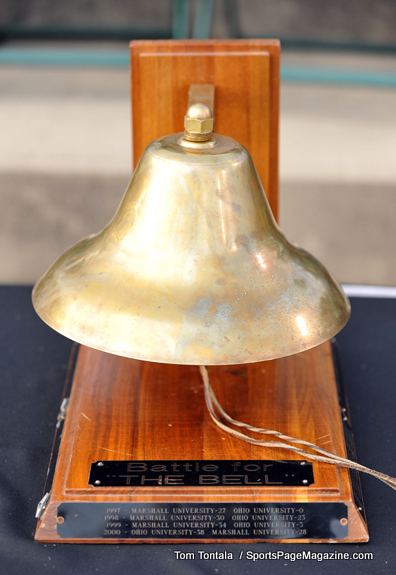
Above: Tom Tontala took this handsome pic of The Bell for SportsPageMagazine.com
The Bell- Marshall Thundering Herd vs. Ohio Bobcats- 9/15/2012
WIITBAFAQ:  What determines if any given game involves a trophy?
You just need two things: a trophy and a game. No really that's all it takes. You don't need to consult some NCAA Committee on Trophy Oversight. No one has to apply for a special permit. It doesn't even require any additional money beyond the price of a trophy, so you can cancel the bake sale. If someone with some connection to at least one of the schools involved wants to put a prize on the line, then you are halfway to the start of a new tradition. In the case of the 'Cats and the Herd, the two schools had played many times dating back to 1905 before there was a keepsake involved. When both teams wound up in the Mid-American Conference in 1997, the schools decided to add some spice to the game in the form of a traveling trophy. A couple of representatives of Marshall and Ohio met in an Athens, OH restaurant to brainstorm. When they realized that the two schools sit on or near opposite sides of the Ohio River, they decided to use a replica of the kind of bells riverboats used to send signals. The trickier part of the equation for the Thunderin' and the Bob's has always been scheduling the game. Thought the schools are only 80 miles apart, they have typically faced each other in intermittent stretches. After Marshall left the MAC in 2004, the two teams didn't face-off until 2009, and that was only because they coincidentally played in a bowl game. The old Bell trophy must have been an after thought, because as best as I can tell Marshall didn't even bring it to the game. (Who do they think they are, Notre Dame?) That renewed the rivalry though, so we now are in the midst of a six season stretch of Battles for the Bell. I am sure there will be more games to come after that. Eventually.

For Those Who Do Not Bowl
Each week I will use this space to highlight one trophy contested between teams from the less covered divisions and subdivisions of college football.


Above: A photo Darrell Rebouche had taken of him and his wife taken next to Chief Caddo. I thank him for its use.
Chief Caddo- Northwestern State Demons vs. Stephen F. Austin State Lumberjacks- 11/17/2012
WIITBAFAQ: Which trophy is the most outrageous?
Over the course of this series you will certainly see a wide range of bizarre trophies. Really the question of which one stands out as the weirdest comes down to a matter of personal taste. So I will answer this question by presenting you with the item that is the most trophy -by which I mean largest- that definitely has caused some outrage.

The largest prize in all of college football stands at 7 feet 6 inches, weighs about 330 pounds and looks like a gigantic cigar store Indian. The statue travels between Nacogdoches, TX -home of Stephen F. Austin State (no relation to Steve Austin)- and Natchitoches, LA- home of Northwestern State (no relation to Northwestern University). It originated in 1960 when the schools agreed to create a highly un-PC statue to mark their rivalry. Like most controversial representations of Native Americans, it began with good intentions. The schools wanted to pay tribute to the legend of  a leader of the Caddo Nation who split control of his people between his sons. According to the legend one of the sons founded Natchitoches and the other Nacogdoches. That is why the two cities can trace their names to the Caddo language. SFASU lost the game the year the statue was planned so they supplied the wood, a 2,000 pound log from a black gum tree. The log was carved down to its current shape over 230 workhours by a man named Harold Green. Ever since then the massive racial stereotype has been a revered symbol of gridiron victory.

In recent years many universities have stopped using nicknames, mascots and other items that made offensive use of Native American imagery. Even beloved football trophies are not immune to this purge. While Texas and Louisiana may not have a reputation for very progressive attitudes, eventually even they had to address the 300 pound injun in the room. The Texas Board of Regents -which has authority over public universities SFASU- called the continued use of Chief Caddo into question. This fired up passions on all sides among Lumberjacks and Demons alike. Eventually the Board quietly put the effort to abandon the trophy to rest. Still, I would suggest you take any opportunity you can to see Chief Caddo now. I doubt he'll be around forever.

Please return to this space each week during this college football season for more information and lore about college football's many trophies. 

Thursday, September 06, 2012

The College Football Trophy Room: Week 2

Enjoy this week's installment of my series on the trophies found in college football. If you need an explanation of the series you can read the introduction. Previous editions in the series are archived under the "trophy room" tag.

The Blue Ribbon Trophy of the Week

Cy-Hawk Trophy- Iowa State Cyclones vs. University of Iowa Hawkeyes- 9/8/2012
The theme of this week's edition is that not every trophy up from grabs on the gridiron is a treasured piece of Americana. Despite what that woman with the stairway to heaven thinks, not everything that glitters is gold. In some way or another the prizes at stake this week seem a cut below the rest, with the possible exception of this week's spotlight piece, the Cy-Hawk Trophy!

http://thegazette.com/wp-content/uploads/2011/08/cy-hawk_trophy.jpg
Above: A picture of Cy-Hawk Trophy Classic from TheGazette.com

No, not that one.

http://www.snarkyhawk.com/wp-content/uploads/2011/08/cy-hawk_trophy_new.jpg
Above: A photo from Schwinn Gunnamiss of . . . words just can't describe it.
 No, that's not it anymore either (thank heavens).

Above: The proposal for Cy-Hawk Trophy III designed by Rickabaugh Graphics
That's the one, or at least the design for it. The actual trophy hasn't been made available for photographs at the time of this writing.

The Cyclones and Hawkeyes will be playing for the third variation on the Cy-Hawk trophy in as many years for reasons that no one in the state of Iowa (let alone this blogger) can seem to fully understand. The original Cy-Hawk Trophy, seen at the top, dates back to 1977. Bob Uetz a school teacher from Ames, IA, helped create a sturdy and respectable trophy that served as corporeal bragging rights for decades. Then the sponsors got involved, and as usual, nothing good came of that. The classic hardware was retired to the Iowa Hall of Pride. The well-intentioned folks from the Iowa Corn Growers Association offered to design a new trophy. That seemed like a natural fit given the list of things outsiders associate with Iowa:
1. Corn
2. The Iowa Caucus (in Presidential Election years)
3. Wheat
4. Corn
5. Grant Wood
6-11. Corn
12. College Football
Except, it seems as though no one vetted the ICGA on their history designing things.
Iowa Corn Indy 250 qualifications explored and explained
Above: A photo by Edmund Jenks of the Iowa Corn version of a super-hero

The hardware that the Iowa Corn Growers thought best represented a fierce football rivalry that pits neighbors against each other was a metalic shrine showing a family kneeling around the alter of freshly harvested corn. The ensuing blowback of public criticism made the responsible parties quickly withdraw the 4-H inspired monstrosity and promise to allow the public a vote in the next trophy.  The new Cy-Hawk Trophy became the old trophy fast that last year, the game's organizers had to use a substitute to award to the winning team. That knickknack didn't even last until the end of the post-game celebration. Now we have a new chance for trophy redemption. Hopefully the item revealed on Saturday will inspire pride in Iowans of all persuasions and have a nice long shelf-life (at least until the sponsor changes).

Spoils of the Game- Week 2
This is where we take a look at all the prizes at stake in this week's games.

http://www.trophyawards.com/custom%20awards/images/RiverCityRivalry.jpg
Above: A pic, via trophyawards.com, of the less than sacred Paddlewheel Trophy
Paddlewheel Trophy- Cincinnati Bearcats vs. Pittsburgh Panthers- 9/6/2012
I tried to warn you at the offset that the keepsakes featured this week weren't exactly keepers. In the case of the Paddlewheel Trophy it seems as though nobody from Cincinnati or Pitt will be sad to see it go. When Cincy joined the Big East conference in 2005, they colluded with Pitt to juice up a rivalry between them. They called in "The River City Rivalry" which is good, because, as Matt Opper of Down the Drive put it Pittsburgh and Cincinnati are "two cities that share a river a little else". Unfortunately the prize offered to the victors failed to inspire much devotion. Now with Pitt leaving the Big East at the end of this season, the trophy may be mothballed for a long time after Thursday night. That's kind of shame because after seven straight Panther victories the two schools have played four very competitive games in the last 4 years and were just starting to build a real hatred for each other. In the end fans of UC and Pitt both dismiss the Paddlewheel. Matt Opper described it as "kind of an abomination". Anson Whaley, from Cardiac Hill, adds that it is "ridiculously large", because at about 4 feet tall and 95 pounds it's the size of most punters. So if the Paddlewheel Trophy goes into storage after Thursday, I guess you'll want a large and opaque box.

Above:A picture from PurdueSports.com of the mounted wooden club called the Shillelagh Trophy

Shillelagh Trophy- Notre Dame Fighting Irish vs. Purdue Boilermakers- 9/8/2012
For other football programs the Shillelagh Trophy might be a big deal, but among Notre Dame's many trophy games and all the high-profile prizes at stake in the B1G Ten it sort of gets lost. The trophy originated in 1957 because a merchant seaman who was a big Irish football fan (Is there any other kind of merchant seaman?) donated an authentic historic shillelagh from Ireland. That's the sort of folksy lore about a trophy I really enjoy. On the other hand, if I were a Boilermaker, I would be insulted that this prize didn't even represent Notre Dame's most prestigious shillelagh themed trophy. That position is filled by the Jeweled Shillelagh Notre Dame shares with the University of Southern California. At least it's the best trophy Notre Dame shares with another team from Indiana, so that's not nothing.

For Those Who Do Not Bowl
Each week I will use this space to highlight one trophy contested between teams from the less covered divisions and subdivisions of college football.

Traveling Training Kit
Above: The Traveling Trainer's Kit from Minnesota's greatest Division II rivalry as pictured on MSUMavericks.com
The Trainer's Kit- Minnesota State- Mankato Mavericks vs. St. Cloud State Huskies- 9/15/2012
In the hearts and minds of college football fans any item can become a treasure. That's the only way you could transform an empty tackle box into a coveted prize, by baptizing it with school pride. Back in 1978 Minnesota State- Mankato (School slogan- "It's not that cold") and St. Cloud State (Effectively named for the patron saint of -I kid you not- nail makers) had not played a football game in 5 years. To celebrate the renewal of the rivalry, the athletic trainers from each school used a symbolic "trainer's kit" as the spoils of the game. Since then the Trainer's Kit has grown capital letters and become a cherished item. In a 2004 piece from ESPN.com, Jeff Merron quotes a Husky player, "We plan on bringing the Trainer's Kit home with us," he said. "We may have to put a new coat of varnish on her. She's looking a little rough." That's more care and attention than some football players show their mothers.

As an added bonus, I love that this is a trophy that has a practical application. Based on what I've read the Trainer's Kit has no contents, but I think it would be awesome if it carried a functional set of equipment for an athletic trainer. What's more, I think the fully stocked Trainer's Kit should be the only equipment allowed on the sidelines at the game. It would be even better if the previous year's winner was the only team allowed to access the kit for their trainer's supplies during the game. Actually, come to think of it, the NCAA may take issue with that last idea. Besides, even if the players' health depended on winning that kit, I don't think they could care about it anymore than they do now.

Please return to this space each week during this college football season for more information and lore about college football's many trophies. 

Saturday, September 01, 2012

The College Football Trophy Room: Week 1


Enjoy this week's installment of my series on the trophies found in college football. If you need an explanation of the series you can read the introduction. Previous editions in the series are archived under the "trophy room" tag.

The Blue Ribbon Trophy of the Week


http://media.scout.com/Media/Image/34/347630.jpg
Above: A  photo of the most West Virginian trophy ever. Taken from GoHerd.com
Friends of Coal Bowl Trophy- Marshall Thundering Herd vs. West Virginia Mountaineers- 9/1/2012 
To start the season, I want to focus on a trophy that may enjoy it's final Saturday in the sun for quite some time this week. West Virginia has two teams that compete in FBS-level football, so it would seem natural for the two to play every year. Yet this Saturday marks only the twelfth time the two have met. It will also be the last time the two teams play for the foreseeable future. So to commemorate the occasion I would like to share a little information about the Friends of Coal Bowl Trophy. 

The trophy was conceived as part of package to fire up a rivalry between the Marshall and WVU. The arrangements for the series had to be negotiated by West Virginia's governor at the time (college football being one of the most pressing issues facing the chief executive of any state). A series of games was scheduled to begin in 2006, and a suitable prize had to be made. For a game between West Virginia schools, the trophy had to cram as much West Virginia stuff into one physical object as the laws of physics would allow. You start with a carbon base from Clarksburg, WV. Then you add a face plate made in Charleston, WV which has been engraved at Alum Creek, WV. After that go to Williamstown, WV, so a glass blower can shape you an ornamental trophy shaped like a football. Next dig up some coal from the state's largest coal seam in Scarbro, WV. Take that to Amsted, WV to liquefy it. Finally you pour the coal inside the glass football to create a trophy that's so Appalachian it should be the subject of a Loretta Lynn song,

All of that seems like the sort of thing that should inspire a wave of provincial pride that draws all West Virginians together. However, the Friends of Coal Bowl has drawn controversy from multiple quarters. Some want to see this trophy retired because it has never changed hands. In fact Marshall has never defeated West Virginia on the gridiron. In 1997 the Thundering Herd even had Randy Moss and still couldn't win -actually after Super Bowl XLII that's not so surprising. So it can hardly seem like a rivalry if the WVU janitor never has to unlock the trophy chest. Even if Mountaineers were forced to surrender the hardware, some still feel the whole thing is too contrived to last. A rivalry has to evolve as the natural product of repeated contests and steadily increasing animosity between the two organizations. 

Setting aside questions about a competitive mismatch, political controversy has tainted the Friends of Coal Bowl. (You have no idea how many times I've tried to type either "cowl" or "boal" while writing up this blog post.) Critics have found it distasteful that an openly political organization like Friends of Coal was awarded naming rights to the game, without so much as a competitive bidding process. Though I cannot come up with any institution that would want to be associated with a sporting event in West Virginia more than the coal industry, with the possible exception of John Denver's estate. This has led others to use the game and its associated trophy as examples of some sort of corrupt political process. It gives the impression that this trophy game exists solely to allow various power brokers to curry favor with each other. In response, I say that there are lots of unsavory things power brokers do to curry favor. At least this time the rest of us got a football game and a unique trophy out of it.

Spoils of the Game- Week 1
This is where we take a look at all the prizes at stake in this week's games.
http://events.colostate.edu/export/728131857Centennial-cup.jpg
Above: The winning team in the Rocky Mountain Showdown gets to hoist the Centennial Cup, from ColoState.edu
Centennial Cup- Colorado University Buffaloes vs. Colorado State Rams- 9/1/2012
No collegiate sporting event in the state of Colorado draws more fans than the battle between the Rams and the Buffaloes for the Centennial Cup. The trophy owes its name to the nickname for the state of Colorado, The Centennial State. That nickname arose because President Ulysses Grant thought a good way to mark the USA's 100th birthday was to admit Colorado to the Union. (Perhaps I should note that Grant was a notorious drunk, remembered not for being president, but for an uncomfortable Palm Sunday he spent with Robert E. Lee.) I cannot determine when the trophy was introduced to the rivalry. Some sources insist that every game between the team has been for the cup going back to 1893. If you believe that, then you probably think this is an authentic portrait of Benjamin Disraeli.

http://cardinalsportszone.files.wordpress.com/2012/08/governors-cup.jpg
Above: The ornate Governor's Cup that Kentucky and Louisville play for, pic from CardinalSportsZone.com
Governor's Cup- Kentucky Wildcats vs. Louisville Cardinals- 9/2/2012
Since 1994, these two schools have exchanged their version of  Governor's Cup (for there are others) to signify football dominance in the Commonwealth of Kentucky. The trophy itself looks pretty and it seems to have the desired effect of incentivising a strong performance from both teams. In the last 12 years Kentucky has only one 4 times in their first game at an opponent's stadium, all of them were at Louisville. Similarly those were the only 4 home openers the Cardinals have lost in the last 14 years, but they have won two of the last three games played at Louisville. (All of this is starting to sound like I'm promoting a gambling tout's hotline, so I'll move on.) My main issue is that the Governor's Cup doesn't seem especially prized by other school. Both of these universities make basketball their number one athletic priority. When the Wildcats and the Cardinals met in the 2012 Final Four, it was said to "transcend imagination". I would guess that that sort of hyperbole will never be deployed to describe a game for the Governor's Cup. 

For Those Who Do Not Bowl
Each week I will use this space to highlight one trophy contested between teams from the less covered divisions and subdivisions of college football.

Above: The bronzed cleats of Myron Claxton, photo from OxyAthletics.com
 Myron Claxton's Shoes - Occidental Tigers vs. Whittier Poets- 11/3/2012
The hardware that appear farther up in this post have prestige and fame, but they cannot match the pure whimsy of a keepsake like Myron Claxton's Shoes. The story of this pair of bronzed sneakers dates back to 1939. Even then these two Southern California schools had a pretty good rivalry. After six straight Poet victories, the animosity had reached a level that members of the Occidental football team attempted to sabotage Whittier's All-American tackle by stealing his football cleats on the night before the game. Undeterred, Claxton took the field wearing his work boots. The Poets thumped the Tigers 36-0 and after the game Myron Claxton reclaimed his shoes from the Occidental sideline. Claxton would be selected in the next NFL draft, last overall pick a.k.a. Mr. Irrelevant, but still he was drafted. When the two schools met in 1946, a Whittier fraternity had bronzed the booties and placed them up to be claimed as booty by the winning team. The Tigers won that game and the boots have been handed back and forth ever since.

There is one more aspect of this game that interests me. In 1939, the man who would become the most famous Whittier alumnus, President Richard Milhous Nixon, was living in the area practicing law professionally. It is very possible that he attended the game to cheer on his Poets. However I somehow doubt this. If he had seen Claxton triumph over the Tigers' prank, surely he would have learned the dirty tricks do not pay.

Please return to this space each week during this college football season for more information and lore about college football's many trophies.